Too Pretty to Work: How Your Stunning Wallpaper Might Be Quietly Killing Your Focus
Photo: MPourzaki (WMF), CC BY-SA 4.0, via Wikimedia Commons
Let's be honest — finding the perfect wallpaper feels great. You scroll through dozens of options, land on something stunning, slap it on your desktop, and for about ten minutes you feel like you've finally got your digital life together. Then the work starts, and somewhere around hour two, you're exhausted in a way you can't quite explain.
Here's a theory worth sitting with: that wallpaper you love might be the problem.
It sounds counterintuitive. You picked it because it speaks to you — maybe it's a hyper-detailed illustration of a neon Tokyo street, or a sweeping aerial photograph of the Colorado Rockies, or a richly saturated abstract that looks like something hanging in a gallery in Brooklyn. It's art. How could art be hurting you?
The answer has everything to do with how your brain handles visual noise — and it's more fascinating (and fixable) than you might think.
Your Brain Doesn't Get a Day Off
Here's something cognitive researchers have known for a while: your brain is constantly processing everything in your visual field, whether you're consciously paying attention to it or not. This is called pre-attentive processing, and it's basically your brain's always-on background scanner.
When your desktop wallpaper is visually complex — lots of fine detail, high contrast, multiple competing focal points — that scanner works overtime. You're not looking at your wallpaper while you're writing an email or building a spreadsheet, but your visual cortex is still quietly cataloging it. Every intricate texture, every saturated gradient, every tiny element in a busy illustration is consuming a small slice of your cognitive budget.
And your cognitive budget? It's not unlimited.
Researchers studying attentional resource theory describe mental focus as a finite resource that depletes with use. Distractions — even passive, peripheral ones — draw from the same pool you use for actual thinking. By the time you hit 3 p.m. and you're struggling to write a coherent paragraph, part of that drain may trace back to hours of your visual system quietly wrestling with the stunning chaos behind your app windows.
The Saturation Trap
Color is its own conversation. Highly saturated backgrounds — think electric blues, vivid magentas, neon greens — are genuinely stimulating to the human nervous system. That stimulation isn't always bad. In short bursts, vibrant color can boost mood and even spark creativity.
But sustained exposure is a different story. Studies on environmental color psychology suggest that high-saturation environments raise cortisol levels over time, nudging your nervous system toward a low-grade stress response. You might not feel stressed exactly, but you may notice you feel oddly drained or irritable after a long work session — and your electric-purple galaxy background might deserve more credit for that than your inbox does.
This doesn't mean you need to switch everything to grayscale and live like a productivity monk. It means context matters. The wallpaper that fires you up for a Saturday morning creative brainstorm might be exactly the wrong choice for a Tuesday afternoon of deep-focus writing.
Decision Fatigue Starts Earlier Than You Think
There's another layer here that doesn't get talked about enough: the micro-decisions your visually complex wallpaper forces you to make without you realizing it.
Every time you minimize a window and briefly glimpse that intricate background, your brain does a tiny orientation check. What am I looking at? Is this relevant? Should I pay attention? It dismisses the image almost instantly — but that dismissal still costs something. Multiply that by dozens of times a day and you've got a meaningful source of decision fatigue that most people never think to blame on their desktop aesthetic.
Barack Obama famously wore the same style of suit every day to eliminate trivial decisions from his mental load. The logic applies here too, just scaled way down. Every unnecessary visual decision your environment forces on you is a small withdrawal from the bank account you need for actual work.
Finding the Sweet Spot (Without Settling for Boring)
None of this means your wallpaper has to be a flat gray rectangle. The goal is finding what researchers sometimes call the optimal complexity threshold — visually interesting enough to satisfy your aesthetic instincts, but not so demanding that it competes with your focus.
A few frameworks worth trying:
Match complexity to task type. Creative work — design, writing, brainstorming — can tolerate more visual richness. A detailed landscape or an artistic illustration might actually support the kind of loose, associative thinking those tasks require. For analytical work — number crunching, coding, editing — lean toward simpler, lower-contrast backgrounds with minimal fine detail.
Watch your saturation levels. Muted, desaturated palettes (think dusty sage, soft terracotta, faded navy) tend to register as visually interesting without triggering that overstimulation response. They have character without shouting. Nature photography with overcast lighting often hits this range naturally.
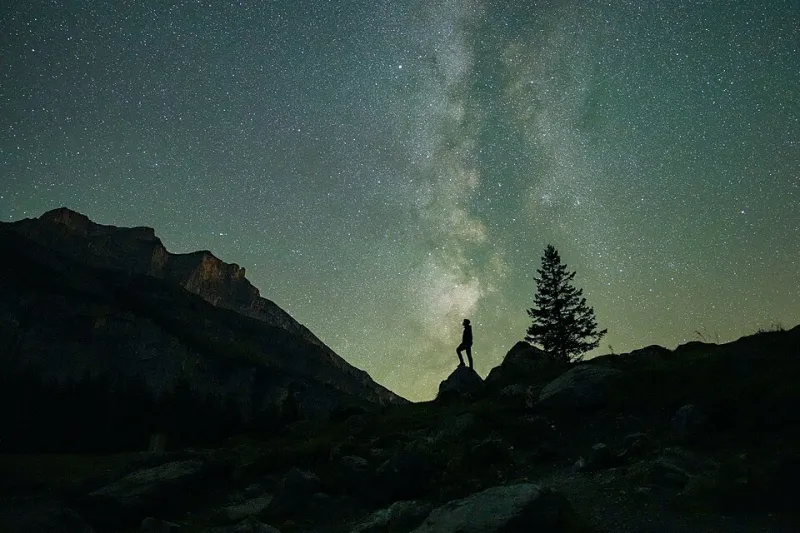
Use depth, not detail. A single subject with strong depth of field — a blurred mountain range, a softly focused forest floor, a lone architectural element against open sky — gives your eye a satisfying place to land without cluttering your peripheral field. Bokeh-heavy photography is particularly good at this.
Consider a time-based rotation. Morning wallpapers can afford to be more energizing and complex. Afternoon and evening wallpapers benefit from calmer, simpler visuals as your cognitive resources naturally ebb. Building a rotation around your own daily rhythm is one of the most underrated productivity tweaks available to you.
Know Your Own Type
Personality matters here too. Research on sensation seeking — a trait that measures how much novelty and stimulation a person craves — suggests that high sensation seekers genuinely tolerate and even benefit from more visually complex environments. If you've always loved maximalist spaces, loud music while working, and a screen full of open tabs, a richly detailed wallpaper might not drain you the way it drains someone who's wired differently.
Pay attention to your own data. If you switch to a simpler background for a week and feel noticeably clearer-headed, that's meaningful. If you feel weirdly flat and uninspired, your brain might actually need more visual stimulation to stay engaged, not less.
The Bottom Line
The best wallpaper isn't necessarily the most beautiful one in your collection. It's the one that serves your brain the way you actually need it to on any given day. That might be a breathtaking panorama when you're in a creative flow state, and a quiet, minimal abstract when you've got a deadline bearing down on you.
At FindWallpaper, we think about backgrounds as more than decoration — they're part of your digital environment, and your environment shapes how you think. The good news is you have more control over that environment than most people ever bother to use. Your pixels are working for you or against you. Might as well make sure they're on your side.